What My Mother’s Loneliness Taught Me About the AI Future
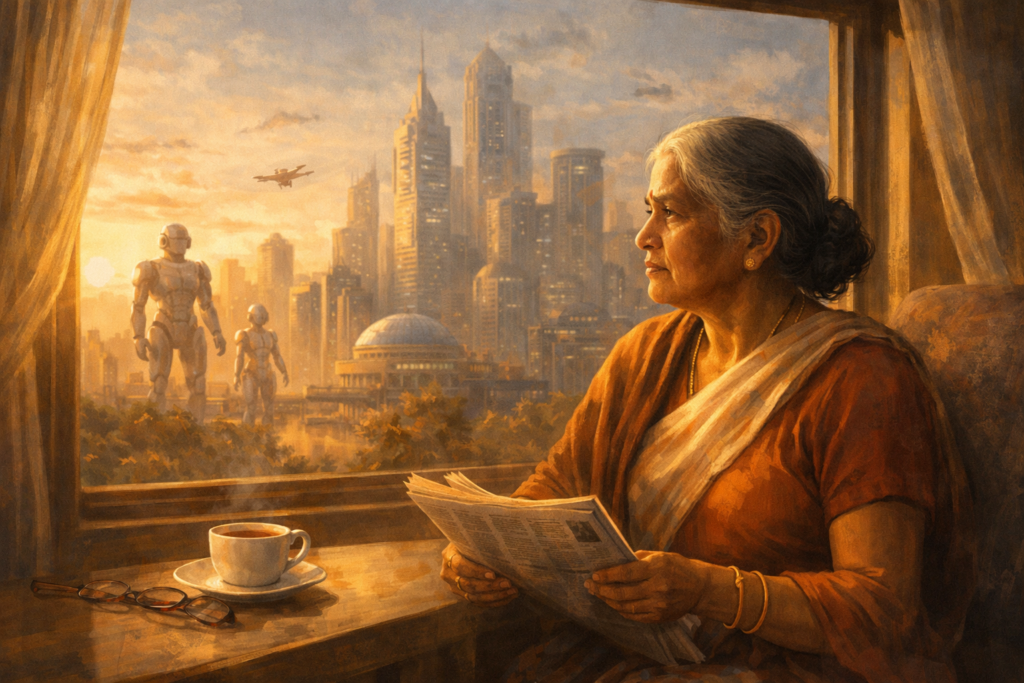
My mother and my brother’s family lived together in a beautiful house. On paper, it looked perfect — she had family around her, comfort, everything she needed. But over time, I noticed something strange happening. She started to fade. Not physically at first, but in ways that were harder to see. The kitchen, which had once been her kingdom, no longer needed her. No one asked her to make chai at four in the afternoon. No one paused at her door to ask which vegetables to cook for dinner. The small things that had made her feel needed — the small things that had quietly held her life together — they were gone.
She had lost something more valuable than money or comfort. She had lost her purpose. And honestly, that loss killed her. Slowly, steadily, it eroded something inside that no amount of love or security could fix.
I spent years trying to name what I was watching. It wasn’t loneliness in the way people usually think about it — surrounded by strangers, isolated in a quiet room. She was surrounded by family. And yet. The days were long. The hours felt empty. And when you have too much time and no reason to fill it, the mind doesn’t celebrate. It collapses. That’s when I understood: sometimes loneliness isn’t about being alone. It’s about not being needed.
This thought has stayed with me. And lately I wonder every single time I read about what’s happening with AI, robotics, and the future of work. Because I see the same thing coming for millions of people.
Why This Matters — And Why You Should Care
Here’s the thing that worries me: most people aren’t paying attention to how fast technology is actually moving. And I get it — the news about AI changes every week. It’s exhausting to keep up.
Think about the Industrial Revolution. It took about eighty to one hundred years — for factories, steam engines, and mechanized production to completely transform how humans lived and worked. People had time to adapt. Children grew up different from their parents. Grandchildren grew up in a completely different world. It was slow enough that society could, in some messy way, figure it out.
Then came the internet. That was faster. From the early 1990’s when the world wide web was still slow dial-up modems to around the mid 2000s when smartphones started changing everything — that was about 15 to 20 years for the internet to go from “cool technology” to “reshaping how we live.” Still disruptive, but there was a window. People could learn, adjust, find new jobs, figure out new ways to survive.
Now look at what happened with ChatGPT. It launched in November 2022. By February 2023 — just two months later — it had 100 million users. To put that in perspective, it took Instagram 2.5 years to reach that many people. It took TikTok nine months. ChatGPT? Two months. And that’s not the end of the story. By 2025, it’s at over 200 million users. The speed is exponential. It’s not something we’ve seen before.
And the changes are already happening in real time — not in some distant future. Dario Amodei, who runs Anthropic, one of the biggest AI companies in the world, has said that AI could eliminate 50% of all entry-level white-collar jobs within five years. 50 percent. In five years. McKinsey estimates that 30% of work hours across the economy could be automated within this decade. This isn’t science fiction. This is happening now. This quarter. This month. Companies aren’t planning for the future of AI — they’re implementing it right now because it saves money and it works.
I’m looking at a tsunami coming our way, and almost nobody is preparing for it.
The Real Problem Isn’t Jobs — It’s Purpose
Here’s what everyone should ponder: we’re so focused on “will there be jobs?” that we’re completely missing the bigger, darker question underneath: “what will people do with their days?”
When my mother had nothing to do, it didn’t just make her sad. It made her sick. The loneliness — the feeling of not being needed — that’s what took her from us. And I watched it happen in slow motion.
Now imagine that happening to millions of people at once. Imagine a world where — in five years, ten years, or twenty-five years, I don’t know the exact timeline — robots and AI and cheap manufacturing have made most jobs unnecessary. Universal basic income arrives. Everyone has money. Healthcare is fine. The basics are covered.
And then what? What do people do on Tuesday morning? What do they do with the eight hours that used to be filled with work — the thing that told them who they were, where they belonged, why they mattered? Because here’s the uncomfortable truth: most people don’t have a plan for that. They don’t have a passion waiting. They don’t have a spiritual practice or a creative hobby or a community service project they’re dying to do.
What most people will do is doom-scroll. They’ll open their phone. One video becomes an hour. One afternoon becomes a month. One month becomes a year. And slowly, their eyes will go a little flat — not from sadness, but from the slow disappearance of days that meant something.
That’s the tsunami I’m terrified of. Not poverty. Purpose poverty. Meaning poverty. The slow, invisible erosion of the things that hold us together as human beings.
What You Need to Know — And What You Need to Do
In India, we have something built into our culture. We have ritual. We have duty. We have the extended family that requires you to show up, even when you don’t want to. We have temples and bhajans and chai with neighbors and obligations that feel like burdens but actually — actually — they’re what keeps us sane.
My grandmother used to cook every single day. It wasn’t a hobby. It wasn’t something she “loved.” It was what she did. And it kept her connected. It kept her needed. It kept her alive.
So here’s what I want to say to you, whoever you’re reading this: don’t wait for AI to force this conversation. Don’t wait until you have nothing but time and no idea what to do with it.
Start now. Find something outside of work that makes you feel alive. It doesn’t have to be big. It could be learning an instrument. Growing tomatoes on your balcony. Teaching neighborhood kids to read. Joining a sports club. Volunteering at a clinic or a temple or a school. Building something with your hands. Writing. Drawing. Singing. Keep pets to care for. Anything that makes you feel like you’re contributing, like you’re part of something, like you matter.
Because in the AI era that’s coming — and it is coming — the people who will survive best won’t be the richest. They’ll be the ones who figured out, long before the robots arrived, that their worth wasn’t tied to their paycheck. They’ll be the ones who built communities. Who learned to create, not just consume. Who had rituals and practices and reasons to wake up that had nothing to do with money.
My mother’s story doesn’t have to be everyone’s story. But it will be, unless we start talking about this now. Unless we start building the lives we’ll actually want to live when work disappears.
So yes, save your money. Plan for the future. Be smart about finances.
But please — also plan for meaning. Because that’s what will actually save you.