When a Man’s Hobby Comes Before His Family
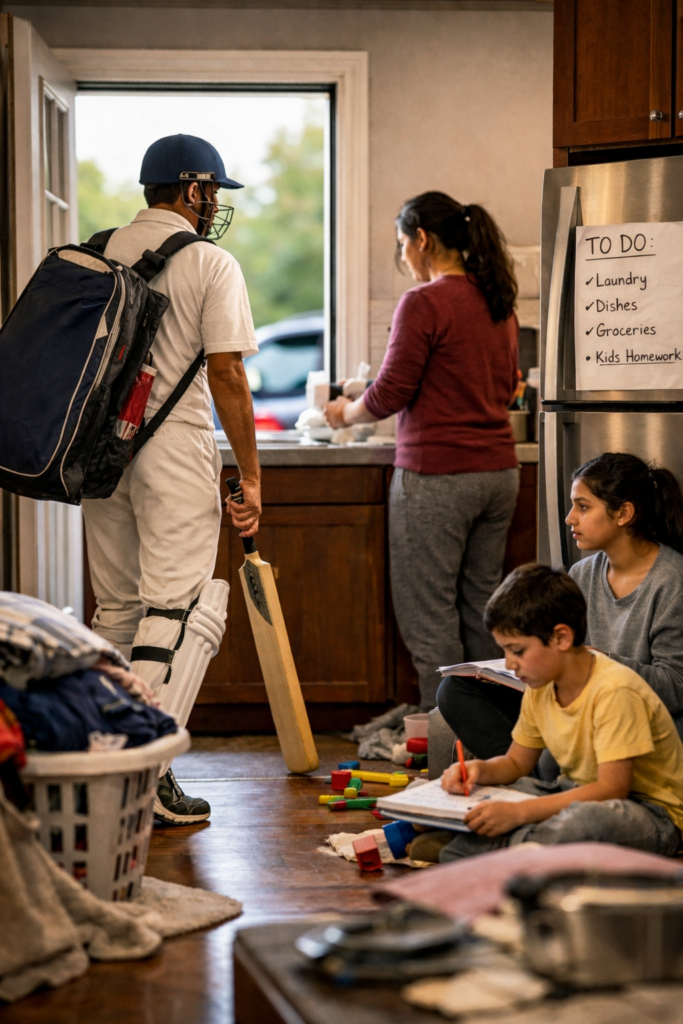
There is a moment every weekend when I already know how the day will unfold. Around noon, my husband picks up his cricket gear and leaves. Saturday and Sunday. Sometimes he returns at five. Sometimes later. The children stay home. The house stays home. And I stay home too — running the quiet, invisible system that keeps a family functioning. Breakfast appears. School bags are packed. Laundry rotates through machines. The small emergencies of childhood are handled. Nothing about this work looks dramatic from the outside. But anyone who has carried a household knows that it is relentless. Life keeps moving because someone keeps moving it forward.
This is not a story about a bad man or a broken marriage. My husband is a good man. He is kind. He works hard. He loves our children. On weekday evenings he takes them to sports activities and sits in the stands cheering them on. In many ways we have built a good life together. We are both professionals. We both contribute to the household income. This is not the old story where the man earns and the woman depends. This is a modern marriage where two professionals share financial responsibility. And yet somewhere inside the machinery of daily life, another equation quietly formed — one where the invisible work of running the family gathered around one person.
Modern marriages have a strange mathematics. Two people earn, but only one person absorbs most of the logistics. Someone wakes up first. Someone remembers the school forms. Someone manages the winter mornings in northern Canada when the temperature falls to minus thirty or even minus forty. Someone keeps track of meals, schedules, emotional storms, and the hundreds of tiny decisions that allow a household to function. Over time that invisible labour becomes like gravity — holding everything together while remaining unseen.
For years I tried explaining this imbalance. Not dramatically, just honestly. I explained how exhausting those mornings can be when the alarm rings at six and the sky outside is still black with cold. I explained how strange it feels when both partners contribute almost equally to the income but only one partner carries the mental infrastructure of family life. Conversations happened. Understanding appeared for a moment. And then the pattern returned. Weekends came again, the cricket bag appeared again, and life continued exactly as before.
Recently I read Gary Chapman’s book The Five Love Languages. One of them is acts of service — the idea that love is sometimes expressed not through words but through action. Through noticing the weight someone else carries and quietly lifting part of it. Through doing something before being asked. When I read that chapter, something inside me paused. Because acts of service are the language I speak every day. Meals cooked, children managed, schedules coordinated, life organized. But when I looked back honestly, I struggled to remember when that language had been spoken back to me in a way that changed my life. Where was the moment when someone said, “Stay home today, I will handle the morning”? Where was the Saturday when he chose to stay instead of leaving for cricket so that I could rest? Where was the small, ordinary gesture that said: I see how much you are carrying.
Life has a way of revealing truths during its most difficult moments. There were weeks when my blood pressure spiked so dangerously high that I ended up in the hospital. Panic attacks followed, the kind where your hands go numb and your body feels like it is losing control. The doctors warned me that these spikes were serious — life-threatening if ignored. But even in those weeks, the mornings did not stop. The children still had to be prepared for school. Breakfast still had to appear. The system did not pause. And somewhere inside that routine lived a quiet assumption that I would manage — because I always had.
After enough years of repeating the same conversations, something shifts inside a person. It is not a dramatic explosion. It is quieter than that. You stop asking. You stop explaining the same truth again and again hoping it will finally land. And when asking stops, something else begins: planning.
This is the moment many women reach quietly in long marriages. It does not mean they stop loving their partner. It does not mean they destroy the family they have built. It simply means they begin to see time differently. My younger child is seven. In ten years he will be seventeen. My older child will be in her mid-twenties. The intense caregiving years — the early mornings, the constant illnesses, the endless school logistics — will eventually pass. Childhood always moves faster than we think.
And when that chapter closes, something else begins.
My time.
I say that without bitterness. I say it with clarity. I will probably write the books that have been forming quietly in my mind. I will travel on my own terms. I will build ideas, communities, and work that matter to me. I will create things that are not squeezed into the corners of my life but placed at its center. In many ways I will simply be doing what my husband has done all these years — pursuing something that brings me joy.
But I will do it from a place of freedom.
People sometimes ask me how I avoid becoming bitter. The honest answer is that I allow myself to feel the anger. Anger is not always destructive. Sometimes it is simply a signal that something unfair exists. I do not pretend the imbalance is fair. I do not convince myself that exhaustion is noble or that sacrifice must always be silent. I acknowledge the truth: that my health, my time, and my energy have often been stretched to keep our family running.
But anger alone cannot be the story of a life.
So I hold two truths at the same time. I am patient, and I am angry at the unfairness. I recognize the imbalance in how our time has been valued. I continue the marriage we have built, and at the same time I quietly design the future that will belong to me.
Perhaps one day the tables will turn. Perhaps when the children are grown and life slows down, he will look back and realize how many mornings I handled alone. Perhaps he will remember the hospital visits, the blood pressure spikes, the weeks when I pushed through fear and exhaustion because the family still needed to function. Maybe that realization will come. Maybe it will not.
The deeper lesson here is not about one marriage. It is about something many South Asian women eventually recognize: love, responsibility, and unfairness can exist in the same relationship. Patience and anger can live in the same heart.
But patience is not the same as surrender.
Time is the most valuable asset a human being owns. And the moment a woman realizes that no one else is going to guard hers, she begins guarding it herself. Not with dramatic ultimatums. Not with bitterness. But with clarity. With boundaries. With quiet decisions about how the next chapter of her life will be lived.