My Father Built His Law Practice on Typewriters. My Children Are Growing Up in the Age of AI.
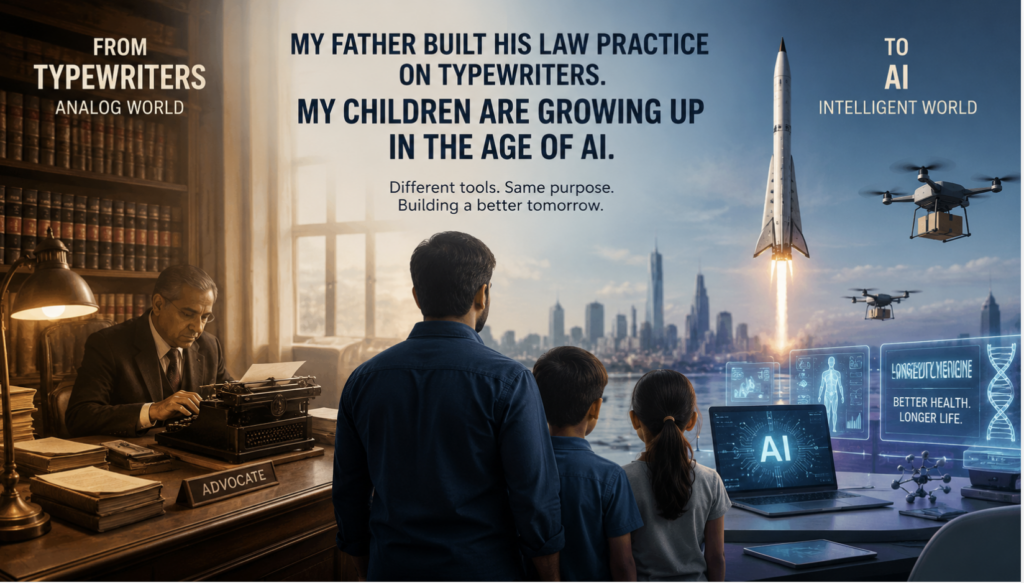
My father was a lawyer, and one of my clearest childhood memories is his stenographer hammering away on the typewriter in his office. Tak-tak-tak-tak. Every letter struck with force. Every mistake required correction fluid, patience, and sometimes an entirely new page. There were no backspace buttons solving problems instantly. Documents were physical. Multiple copies had to be typed manually. Then slowly computers, printers, fax machines, and eventually voice mail systems started entering offices and homes, quietly transforming how humans communicated and worked forever.
Our television was black-and-white before colour TVs slowly entered middle-class homes in early 1980’s. Entertainment had weight back then. Cassettes lived in drawers. VHS tapes sat stacked beside televisions like prized collectables. Rewinding a movie was an actual responsibility. Microwaves felt futuristic. Cable TV felt luxurious.
In the 1990s and early 2000s, the world accelerated. Nokia mobile phones appeared like magical bricks that somehow let people talk while walking outside. CDs replaced cassettes. Cyber cafés appeared everywhere. Then came Google, Wikipedia, Amazon, YouTube, Facebook, online books, GPS maps, smartphones, WhatsApp, streaming, and free international calling.
And suddenly humanity no longer had to wait for information. We adapted so fast that we stopped being amazed.
Think about this carefully. One generation witnessed:
- typewriters become obsolete
- landlines disappear
- physical maps vanish
- cameras disappear into phones
- shopping malls compete with apps and online shopping
- cable TV lose relevance
- human conversations evolve into emojis and video calls
The future didn’t arrive slowly. It exploded quietly.
And then came artificial intelligence.
I genuinely believe ChatGPT and generative AI represent one of the biggest technological turning points since the internet itself. But another breakthrough that deserves far more public awe and appreciation is what SpaceX and Elon Musk achieved with reusable rockets.
Think about how extraordinary this really is. Airplanes themselves are barely a little under a century old. For most of human history, flying across continents was impossible. And now, within one lifetime, humanity is building rockets that can launch into space and then land themselves back on Earth vertically like scenes from science fiction movies.
Let that sentence sink in for a moment.
For decades, rockets were treated as disposable machines — used once and destroyed forever. SpaceX challenged that assumption completely. And if reusable rocket technology keeps improving, it may eventually transform global transportation, cargo systems, food distribution, disaster relief, and even the economics of poverty itself.
Imagine a future where traveling from Canada to India takes one or two hours instead of an entire exhausting day of airports and layovers. That may sound impossible today, but so did video calls, smartphones, and AI conversations just a few decades ago.
And even if humans do not routinely travel by rocket anytime soon, rocket cargo alone could become revolutionary. Food, medicine, emergency supplies, and critical resources could potentially move across continents at astonishing speed. Artificial supply shortages, inefficient logistics, and massive wastage of food may eventually decrease dramatically with better transportation systems, AI-driven optimization, and smarter global governance.
For the first time in history, humanity has tools powerful enough to potentially reduce suffering at planetary scale — if we use them wisely.
The next 20 years may transform humanity more than the previous 100. Artificial intelligence, robotics, longevity medicine, autonomous vehicles, and renewable energy are no longer distant fantasies. They are active industries shaping the future in real time.
And honestly, longevity medicine may eventually become just as revolutionary as the internet or AI itself.
For decades, humanity accepted obesity, diabetes, metabolic syndrome, fatty liver disease, and chronic inflammation almost like unavoidable consequences of modern life. Entire healthcare systems quietly became overwhelmed by diseases linked to metabolism, processed food, sedentary lifestyles, and insulin resistance. And now suddenly, medications like Ozempic and GLP‑1 therapies are sweeping across the world at astonishing speed.
This is not simply about weight loss.This may become one of the biggest public health breakthroughs of this century.
For the first time, medicine is beginning to directly target the biological systems driving hunger regulation, insulin resistance, obesity, cardiovascular risk, and metabolic dysfunction itself. If these therapies continue improving safely over time, they could potentially reduce heart disease, diabetes complications, strokes, kidney disease, joint damage, and even certain cancers linked to obesity.
Think about how extraordinary that really is.
The internet changed how humans access information. AI may change how humans work and think. But longevity medicine may fundamentally change how long and how well humans live.
But strangely, this article is not really about technology.
It is about human adaptability. Despite all the disruption, humanity kept adjusting. Our parents adjusted. We adjusted. Our children will adjust too. Humans have an extraordinary ability to normalize miracles. I am just grateful that I witnessed the bridge between two civilizations: the analog world and the intelligent world.
Very few generations in history experienced this level of transformation within a single lifetime. And perhaps one day, our grandchildren will look at us the way we once looked at our grandparents.