You’re Not Warren Buffett. Stop Picking Stocks.
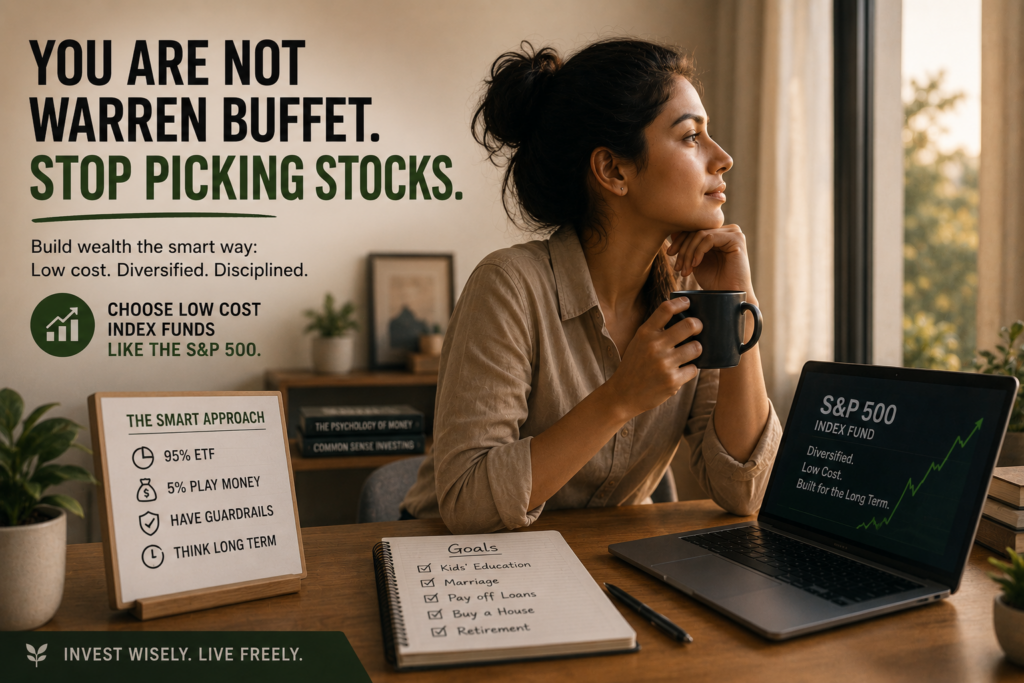
There is something strangely addictive about picking stocks. You read one exciting headline about artificial intelligence, electric vehicles, or a company that “might become the next Tesla,” and suddenly your brain begins to imagine a shortcut to wealth. One tap on a trading app can feel powerful. Intelligent. Sophisticated. For a brief moment, you feel like you’re participating in the secret world of finance.
The stock market has quietly become entertainment. Notifications, charts, YouTube predictions, Reddit excitement, financial influencers screaming about “massive upside” — it all creates the illusion that wealth is built through constant action. In reality, wealth is usually built through patience, discipline, and long periods of boredom.
The uncomfortable truth is this: the average investor dramatically underperforms the market itself. According to DALBAR studies, individual investors have historically earned far lower returns than the S&P 500, not because they lack intelligence, but because they behave emotionally. Human beings panic when markets fall and become greedy when prices rise. We buy after excitement and sell during fear. That behavior gap quietly destroys decades of compounding. Morgan Housel, author of The Psychology of Money, explains this beautifully: financial success is less about knowledge and more about behavior. But before choosing investments, most people skip the most important step entirely — defining their actual financial goal. Is the money for children’s education? Paying off student loans? Buying a house? Replacing a car? Retirement? Financial freedom? Generational wealth? Without a clear goal, investing becomes random emotional behavior instead of a structured long-term plan. Most people spend more time researching the “next big stock” than understanding their own timeline, risk tolerance, and real-life financial priorities. They never ask simple questions like: How much volatility can I emotionally survive? What is this money actually for? What happens if this stock falls 50%? Instead, they chase stories because stories feel exciting. Index funds feel boring. Yet boring has historically built far more wealth than excitement ever did.
Stock Picking is difficult, you have to understand who you are competing against. Behind every publicly traded company are armies of analysts, hedge funds, institutional investors, economists, AI systems, and professional portfolio managers working full time to gain even a tiny edge. Entire firms analyze one sector for years. They study earnings reports, debt structures, management quality, global supply chains, regulation changes, consumer behavior, and macroeconomic shifts. Even with all those resources, they are often wrong. And then there is the average individual investor trying to “beat the market” between work meetings, family responsibilities, Instagram scrolling, and occasional YouTube videos. Warren Buffett himself — arguably the greatest investor in modern history — repeatedly tells people not to pick individual stocks. In his famous recommendation for his own family’s inheritance, he suggested a simple low-cost S&P 500 index fund. That sentence alone should make most people pause. The world’s most famous stock picker essentially told investors to stop trying to become him.
Timeline and Risk Tolerance – What makes this conversation even more important today is how investing has become deeply emotional and social. Stock tips spread through WhatsApp groups, TikTok clips, podcasts, lunch conversations, and social media algorithms designed to amplify excitement. Someone tells you about a “hot stock,” and suddenly you feel like you might miss out forever if you don’t act immediately. But your friend’s financial goals are not your goals. Their timeline is not your timeline. Their risk tolerance is not your risk tolerance. A 25-year-old software engineer in Toronto with no children can survive financial volatility very differently than a 45-year-old parent trying to protect retirement savings. Yet people blindly copy investments every single day without understanding the deeper context.
Ignore the noise and BNN – There are no viral headlines about low cost diversified index funds. But historically, that quiet strategy has outperformed most active investors over long periods. You automate contributions, ignore short-term noise, continue through market crashes, and allow compounding to do its slow invisible work. That process lacks adrenaline, which is exactly why most people struggle with it.
But modern investing platforms and social media algorithms make that clarity very difficult. The moment you start researching Bitcoin, cryptocurrency, Tesla, AI stocks, or “the next big investment,” algorithms immediately begin feeding you more of the same content. Suddenly your YouTube homepage, Instagram feed, TikTok videos, podcasts, and ads become flooded with people explaining why this investment will ‘change everything.’ The internet quietly creates an echo chamber around your curiosity. You stop hearing balanced opinions and start hearing only excitement.
That is dangerous because every investment has risks people conveniently ignore during hype cycles. Cryptocurrency can swing 20–50% in months and destroy sleep for average investors. Individual companies can collapse from competition, bad management, lawsuits, or technological disruption. Even trendy ETFs are not automatically safe. Today there are hundreds of ETFs for everything — crypto ETFs, leveraged ETFs, gold ETFs, AI ETFs, speculative sector ETFs — all with different risks and management fees. Not all ETFs are created equal.
What I am promoting here is something much simpler: low-cost broad-market investing through an S&P 500 index fund. The S&P 500 represents roughly the top 500 companies in the United States, and it automatically evolves over time. Weak companies get removed. Stronger companies take their place. You are not trying to predict one winner — you are buying a small piece of American business innovation itself.
For most people, a simple guardrail may work far better than emotional investing. Something like 95% in diversified low-cost ETFs and maybe 5% as ‘play money’ for individual stocks or speculative ideas. If someone has $100,000 invested, perhaps $95,000 belongs in long-term diversified investing and only $5,000 goes toward trying individual stocks, crypto, or higher-risk bets. That way curiosity cannot destroy your financial future. Long-term goals usually require discipline far more than brilliance. The market has always rewarded patience more consistently than prediction. You do not need to become the next Warren Buffett to build wealth. You simply need to stop behaving like the average emotional investor.
And maybe that is the hardest lesson of all.